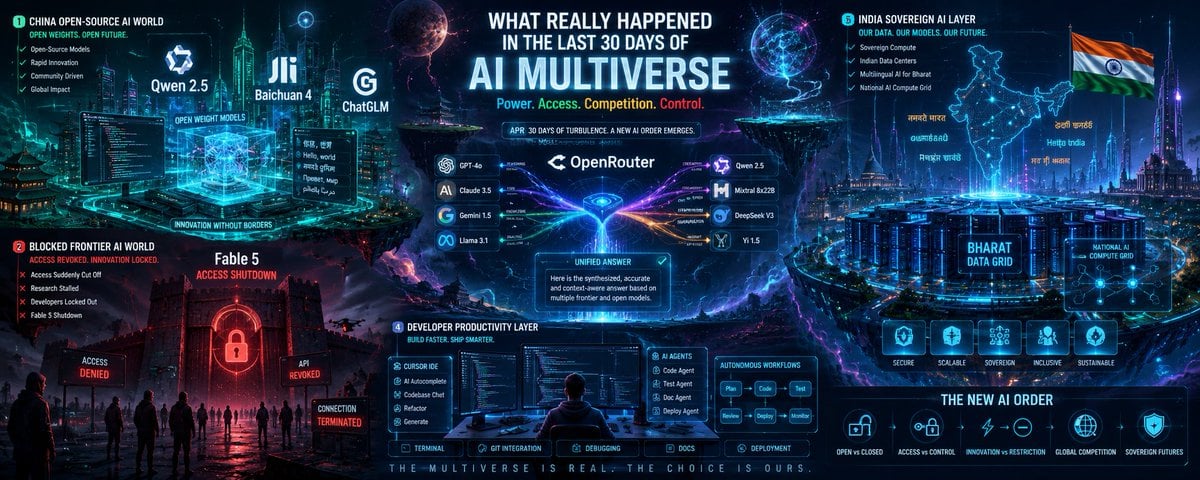
The Last 30 Days of AI Multiverse
June 2026 was wild. Not in the "another GPT wrapper" way, but in the "wait, what just happened?" way.
China quietly dropped a bunch of open-source models that made frontier labs sweat. The US government walked in and took away the most anticipated model of the month from almost the entire world. SpaceX bought a coding IDE for $60 billion. And India’s most serious sovereign AI company raised meaningful money, but the round still felt small when you compare it to what this race now demands.
So let’s go through what actually happened in the last 30 days of the AI multiverse.
China’s open-source stack stopped looking "secondary"
If there is one big shift from the last month, it is this: Chinese open-source AI is no longer something you mention as a budget alternative. It is now something you compare directly with top closed models.
GLM-5.2 is probably the cleanest example. Z.ai released it with MIT open weights, a 1 million token context window, and a 753B parameter size. On Code Arena Frontend, it ranked number two globally and sat just below Fable 5. That matters even more because Fable 5 is now effectively inaccessible for most of the world. So for a large part of the developer ecosystem, GLM-5.2 is not just impressive. It is one of the best actually available options.
The benchmark story is what makes people take it seriously. GLM-5.2 reportedly beats Claude Opus 4.8 on SWE-Bench Pro, edges ahead on some agentic benchmarks, and stays close enough on harder long-horizon tasks that the tradeoff becomes obvious: much lower cost for quality that is in the same tier for many real workflows. Its API pricing is also dramatically lower than Opus, which is why so many users on Reddit, X, and developer circles started describing it as something close to Opus-level quality at a fraction of the price.
Then came Kimi K2.7 Code. Moonshot positioned it as an open-weight coding model focused on agentic loops, long coding sessions, and tool use. It is a 1 trillion parameter model with a 256K context window, and its benchmark deltas over K2.6 were big enough to get attention. If you care about coding agents rather than one-shot demos, Kimi K2.7 matters.
MiniMax M3 added another layer to this trend. The pitch was bold: frontier coding, 1M context, and native multimodality in one open-weight model. Pricing was also aggressive. If you zoom out, the point is simple. China is not releasing one lucky model. It is releasing a full stack of strong models across coding, agentic use, long context, and multimodal tasks.
DeepSeek V4 also remains part of this story. It carried the open model narrative forward with around 1T parameters, 1M context, and strong coding and reasoning numbers. By this point, the pattern is hard to ignore. Open-source Chinese models are now competing on actual capability, not just on ideology.
GLM-5.2 is the model that made the conversation serious
GLM-5.2 deserves its own section because it changed the tone of the discussion. People were not just saying, "this is good for open source." They were saying, "this can genuinely replace premium closed models for a lot of work." That is a different level of endorsement.
On paper, the specs are already strong: 753B parameters, 1M context, MIT license. In benchmark comparisons, it looked surprisingly close to Claude Opus tier quality on agentic coding and frontend generation. On Code Arena Frontend, it came in just below Fable 5, and it was ahead of other globally available models. That is a huge statement because frontend coding is one of the easiest places to expose a weak model. Users can see poor taste, broken structure, and half-working output immediately.
The bigger point is not just that GLM-5.2 is good. It is that it is open, cheaper, and globally available. That combination is what makes this moment different. A strong model is useful. A strong model that most of the world can actually access is strategic.
Fable 5 went from hype to heartbreak in days
Fable 5 was supposed to be one of the defining model launches of the month. Early reactions made it sound like the new ceiling for long-horizon reasoning, coding, research, and difficult agentic tasks. People were excited for good reason.
Then things turned weird very fast. After the launch, access got cut because of US export control action tied to foreign national restrictions. The result was brutal for everyone outside the US, including Indian developers and builders who had barely started testing it. A lot of the initial joy around Fable 5 quickly turned into frustration because the model that looked like the best thing in town was suddenly not really part of the global market anymore.
That is why this month felt bigger than just benchmark drama. It reminded everyone that the best model is not automatically the most important model. If access can disappear overnight, then practical availability becomes part of the product itself.
OpenRouter’s blend approach became more interesting after the Fable shutdown
One of the more interesting side stories was OpenRouter pushing a blended deep-search style setup as an alternative path. The important idea here is simple: instead of betting on one elite model, route across multiple models and synthesize the result well enough that the final output can compete with a frontier single-model experience.
That approach became much more relevant once Fable 5 access got cut. OpenRouter had already shown that a blended system could perform strongly on Perplexity-style deep research evaluation. So the conversation shifted from "which single model wins?" to "can smart routing and synthesis beat a blocked frontier model anyway?"
This matters because it points to a different future. Maybe the winning product is not always the one with the single best model under the hood. Maybe it is the one that composes multiple models well, handles cost intelligently, and stays resilient when one provider disappears.
SpaceX buying Cursor says the IDE war is now part of the AI race
SpaceX acquiring Cursor for $60 billion was one of those headlines that instantly tells you the market has become strange and serious at the same time. Cursor is not just another editor anymore. It is one of the central interfaces through which developers now experience AI.
That makes the deal strategically important. The IDE is where model quality becomes daily habit. Whoever owns that layer gets distribution, feedback loops, and leverage over how coding agents evolve. So this was not just a flashy acquisition. It was a signal that the battle for AI is not only about labs and model releases. It is also about owning the surface where developers actually work.
India needs sovereign AI, not just access to other people’s models
This month made the sovereign AI argument feel very real for India. When access to a frontier US model can effectively vanish overnight for non-US users, the issue stops being theoretical. It becomes infrastructure policy.
Sarvam AI’s latest round is important in that context. The company announced a $234M first close of a $300M Series B, with HCLTech leading the round. That is serious money by Indian startup standards, and Sarvam is one of the few companies in the country actually trying to build foundational language infrastructure for India.
But if we are being honest, even $300M does not feel enough for India’s full AI ambition. Not when the real race now involves compute, talent concentration, long training runs, distribution, and sovereign control over model access. Sarvam deserves support, but India also needs to think at a much larger scale if it wants to be a participant in the AI race rather than just a customer of it.
So what really happened?
In one month, China’s open-source ecosystem started looking strong enough to challenge the old closed-model hierarchy in a practical way. GLM-5.2 became the face of that shift. Kimi K2.7, MiniMax M3, and DeepSeek V4 reinforced it.
At the same time, Fable 5 showed the opposite side of the story. A frontier model can be brilliant and still become irrelevant for most of the world if access is politically constrained. OpenRouter’s blended research setup then hinted at another possibility: the future may belong not only to the best single model, but also to the best orchestration layer.
And for India, the lesson was hard to miss. If the best tools can be taken away, then sovereign AI stops being a slogan and becomes a necessity.
Liked my article? Follow me here: @Shreyas_Pandeyy
Originally published on X →