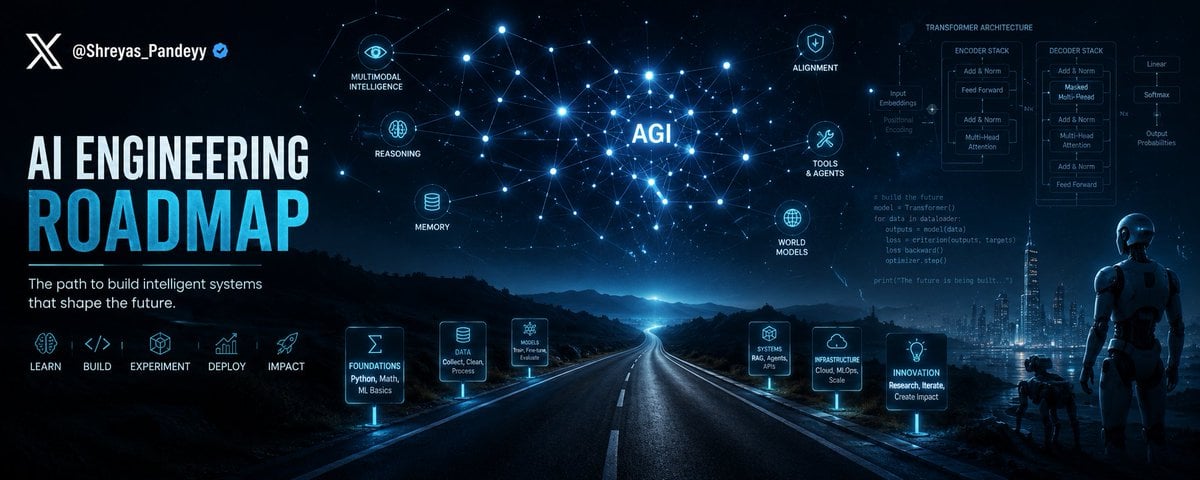
The AI Engineering Roadmap
2026 Edition · Agentic AI
A structured path from Python developer to production-ready AI engineer — with a strong focus on agentic systems, LLMs, and real-world tooling.
Legend: [Core] = everyone must do this · [Optional] = recommended for college students & ML-curious engineers · [Advanced] = after completing the core track
Step 00 — Prerequisites
You should be comfortable here before starting the roadmap.
Python — Intermediate Level [Core]
OOP, decorators, async/await, list comprehensions, typing. If unsure, do the official Python tutorial first.
FastAPI Backend Fundamentals [Core]
REST APIs, async endpoints, Pydantic schemas, dependency injection. FastAPI docs — best-in-class documentation.
Basic Linear Algebra & Statistics [Optional for SWEs]
Vectors, matrices, dot products, probability distributions, mean/variance. You don't need a full maths degree — just enough to read ML papers.
Step 01 — ML Foundations [Optional for SWEs, Essential for College Students]
Who needs this? If you are a software engineer with backend experience, you can skip to Step 02 and return here later. If you are a college student, fresh grad, or planning to do model training/fine-tuning — do this first.
Machine Learning Specialization — Andrew Ng (Coursera) [Optional]
Stanford-backed. Covers supervised/unsupervised learning, decision trees, recommender systems, and RL basics. Best intro to classical ML. Audit for free.
→ coursera.org/specializations/machine-learning-introduction
Stanford CS229 — Machine Learning [Optional]
Andrew Ng's original Stanford course. More mathematical, covers the theory behind ML algorithms. Watch lectures freely on YouTube. Use as an alternative or supplement to Coursera.
→ cs229.stanford.edu
Kaggle — Tabular & Classic ML Competitions [Optional]
After ML fundamentals, pick 2–3 medium-level competitions: Titanic (starter), House Prices (regression), Spaceship Titanic (feature engineering). Gets you comfortable with pandas, scikit-learn, and EDA.
Step 02 — Neural Networks [Core]
Understand how neural networks actually work. This is the conceptual foundation for everything LLM-related.
Neural Networks — 3Blue1Brown (Chapters 1–4) [Core]
The most beautifully visualised intro to neural networks on the internet. Chapters 1–4 cover what networks are, gradient descent, backpropagation, and backprop calculus. ~2 hours total. Watch this first.
→ youtube.com/playlist?list=PLZHQObOWTQDNU6R1_67000Dx_ZCJB-3pi
Transformers — 3Blue1Brown (Chapters 5–7, same playlist) [Core]
Chapters 5–7 of the same Deep Learning playlist cover attention mechanisms and transformers with stunning visual clarity. Watch after Chapters 1–4. Essential before studying LLMs.
→ Same playlist as above — youtube.com/playlist?list=PLZHQObOWTQDNU6R1_67000Dx_ZCJB-3pi
Neural Networks: Zero to Hero — Andrej Karpathy [Core]
Build backpropagation from scratch with micrograd, then language models (bigram → MLP → WaveNet → Transformer). One of the most impactful coding courses ever made.
→ Course site: karpathy.ai/zero-to-hero.html
→ YouTube playlist: youtube.com/playlist?list=PLAqhIrjkxbuWI23v9cThsA9GvCAUhRvKZ
Let's Build GPT: From Scratch — Andrej Karpathy [Core]
The definitive hands-on GPT build. 2 hours. You implement the full transformer from scratch following "Attention Is All You Need." Do this right after Zero to Hero or alongside it.
→ youtube.com/watch?v=kCc8FmEb1nY
Step 03 — NLP & Language Models [Core]
Go from word vectors to transformers and modern NLP architectures through structured courses.
NLP Specialization — Andrew Ng / DeepLearning.AI (Coursera) [Core]
4 courses covering sentiment analysis, word vectors, recurrent networks, attention, transformers, NER, and machine translation. Bridges classical NLP to modern LLMs. Audit for free.
→ coursera.org/specializations/natural-language-processing
HuggingFace LLM Course [Core]
End-to-end course on HuggingFace Transformers, Datasets, Tokenizers, and Accelerate. Covers fine-tuning, PEFT, building NLP pipelines, and deploying to the HF Hub. Do Chapters 1–4 first, then 5–8 for LLM depth.
→ huggingface.co/learn/llm-course/en/chapter1/1
Step 04 — Deep Learning [Optional — Skip if building applications]
Skip this if your goal is building agents and agentic workflows. Come back here if you want to fine-tune models, understand training dynamics, or read research papers fluently.
Deep Learning Specialization — Andrew Ng (Coursera) [Optional]
5 courses: neural networks, improving deep NNs, structuring ML projects, CNNs, and sequence models. The gold standard deep learning intro. Audit for free.
→ coursera.org/specializations/deep-learning
Practical Deep Learning for Coders — fast.ai [Optional]
Top-down, code-first approach. Start with real applications, then understand theory. Great alternative or supplement to Andrew Ng's specialization.
Step 05 — LLM Application Layer [Core]
Calling APIs, prompt engineering, RAG, and building production-grade LLM-powered services.
OpenAI Platform Docs [Core]
Learn the Chat Completions API, function calling, structured outputs, embeddings, and the Assistants API. Read the cookbook too.
→ platform.openai.com/docs/overview
Anthropic Claude API Docs [Core]
Tool use (function calling), extended thinking, vision, and long context. Claude is increasingly used in production agentic systems.
→ docs.anthropic.com/en/docs/welcome
LangChain — Docs + Tutorials [Core]
Chains, LCEL, retrievers, vector stores, memory, and agents. Start with the conceptual guides, then build the RAG quickstart.
→ python.langchain.com/docs/introduction
RAG Fundamentals — Retrieval-Augmented Generation [Core]
Chunking strategies, embedding models (OpenAI, Cohere, HuggingFace), vector stores (Pinecone, Chroma, Qdrant, Weaviate), re-ranking, and hybrid search. Learn from LangChain's RAG tutorial and DeepLearning.AI's free short courses.
Prompt Engineering Guide [Core]
Chain-of-thought, few-shot, system prompts, constitutional AI, and structured outputs. The most comprehensive free reference.
Step 06 — Agentic AI Systems [Core]
The core skill of this roadmap. Tool calling, planning loops, multi-agent systems, and production-grade agent architectures.
LangGraph — Official Docs & Tutorials [Core]
The primary framework for building stateful, multi-step agents. Learn nodes, edges, state graphs, checkpointing, human-in-the-loop, and streaming. Do the full quickstart and the agent patterns examples.
→ langchain-ai.github.io/langgraph
OpenAI Agents SDK [Core]
Lightweight framework from OpenAI for building multi-agent pipelines with handoffs, guardrails, and tool use. A production-ready alternative to LangGraph for OpenAI-based workloads.
→ openai.github.io/openai-agents-python
HuggingFace AI Agents Course [Core]
Free certified course on building AI agents with smolagents, LangGraph, and LlamaIndex. Covers tool calling, ReAct agents, multi-agent orchestration, and vision agents.
→ huggingface.co/learn/agents-course/en/unit0/introduction
Model Context Protocol (MCP) — Anthropic [Core]
The emerging standard for connecting AI agents to tools, APIs, and data sources. Read the spec, build an MCP server, connect it to Claude. This is becoming foundational infrastructure.
→ modelcontextprotocol.io/introduction
LangSmith — Tracing & Evaluation [Core]
Trace every LLM call, evaluate outputs, debug agent chains, and monitor production workloads. Essential for understanding what your agent is actually doing.
Step 07 — Build These 8 Projects
Ship real things. Each project targets a specific agentic AI skill set.
- Project 1 — Deep Research Agent: Takes a question, searches the web (Tavily / SerpAPI), reads pages, synthesises findings, and produces a cited report. Covers: tool calling, multi-step planning, citation management.
- Project 2 — Personal Knowledge Base (RAG): Ingest PDFs or local files into a vector store. FastAPI backend that answers questions with source citations. Add hybrid search (BM25 + embedding).
- Project 3 — Coding Agent with Code Execution: Agent writes Python, runs it in a sandbox, reads errors, and self-debugs. Build with LangGraph or OpenAI Agents SDK. Great for understanding ReAct loops.
- Project 4 — Multi-Agent Workflow System: Supervisor agent routes subtasks to specialist agents (researcher, writer, critic). Implement with LangGraph's multi-agent pattern. Teaches orchestration and handoff protocols.
- Project 5 — AI-Powered API Wrapper Agent: Give an LLM a set of REST API tools (weather, news, GitHub, calendar). Let it decide which to call based on user intent. Deploy via FastAPI.
- Project 6 — Long-Context Document Analyst: Upload contracts or research papers. System extracts structure, answers complex questions, and generates multi-level summaries. Uses Claude or Gemini for long context.
- Project 7 — Autonomous Data Pipeline Agent: Fetches data from an API or scrapes a site, cleans it, runs analysis, and writes a narrative report. Tests planning over multiple heterogeneous tools.
- Project 8 — MCP Server + Agent Integration: Build a custom MCP server exposing 3–4 tools (file system, DB queries, API calls). Connect to Claude Desktop or a LangGraph agent.
Step 08 — Production & Deployment [Core]
Docker + Containerisation
Containerise your FastAPI + agent stack. Compose services (API server, vector DB, Redis for memory).
Langfuse — Open-Source LLM Observability
Trace, evaluate, and monitor every LLM interaction. Self-hostable, free tier. Use alongside or instead of LangSmith.
RAGAS — RAG Evaluation
Evaluate RAG pipelines on faithfulness, context precision, and answer relevancy. Use LiteLLM for model-agnostic routing and cost tracking.
Step 09 — Advanced Topics [After Core Track]
Fine-Tuning & PEFT — LoRA, QLoRA [Advanced]
Fine-tune small open-source models (Llama, Mistral, Phi) with LoRA using HuggingFace PEFT + TRL. Run on free Colab A100s or Kaggle GPUs.
→ huggingface.co/docs/peft/index
RLHF & DPO [Advanced]
How ChatGPT-style models are aligned. RLHF fundamentals, PPO, and Direct Preference Optimisation. Study via Anthropic's constitutional AI paper and HuggingFace TRL.
Inference Optimisation [Advanced]
Quantisation (GGUF, AWQ, GPTQ), speculative decoding, KV caching, vLLM for serving.
→ github.com/vllm-project/vllm
Key Research Papers to Read [Advanced]
- "Attention Is All You Need" — the original transformer paper
- "ReAct: Synergising Reasoning and Acting in Language Models"
- "Chain-of-Thought Prompting Elicits Reasoning in Large Language Models"
- "Toolformer: Language Models Can Teach Themselves to Use Tools"
- "AgentBench: Evaluating LLMs as Agents"
All available free on arxiv.org
Community & Staying Current
- HuggingFace Daily Papers — community-curated research papers, updated daily → huggingface.co/papers
- DeepLearning.AI Short Courses — 1–3 hour free courses on LangChain, RAG, agents, fine-tuning. New ones every few weeks → learn.deeplearning.ai
- The Rundown AI — daily AI news newsletter → therundown.ai
- r/LocalLLaMA — most active community for open-source LLM engineering
- GitHub — read the source code of LangChain, LangGraph, OpenAI Agents SDK, vLLM. Production OSS code teaches faster than any course.
All links verified. Resources marked [Free] are fully free or have a free audit tier. For software engineers: see the companion Fast-Track Roadmap for SWEs. Updated 2026.
Originally published on X →