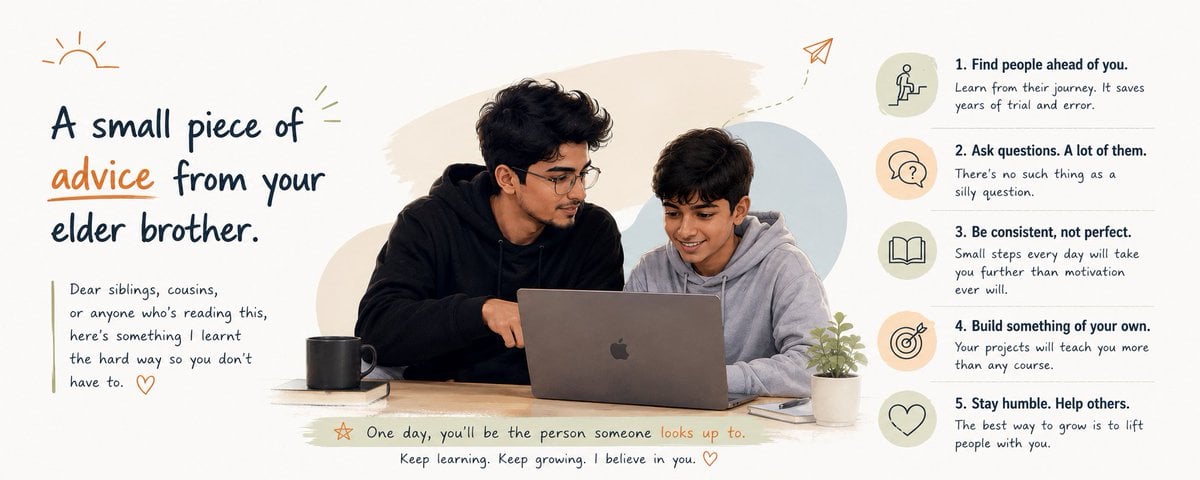
Dear First Year: Nobody Will Tell You This, So I Will
Yaar listen, first year is the most wasted year for 90% of engineering students, and nobody warns you about it. You land up in a new city, new hostel, new friends, and suddenly everyone around you is either lost in the fear of "how do I survive four years of this" or blindly chasing marks like that's the only currency in life. I'm writing this like your senior who's already made the mistakes so you don't have to. Nobody sat me down in my first year and told me these things, I figured them out the hard way, after wasting semesters chasing the wrong things. So take this as the one long conversation I wish someone had with me on day one.
Stop Chasing CGPA Like It's Everything
CGPA gets you shortlisted for placements, that's it, it doesn't get you a job, a startup, or a skill. Keep grades "good enough," not perfect, because burning your whole first year on assignments and rote learning eats the time you should spend building. I've seen toppers with a 9.6 CGPA sit jobless because they never wrote a single line of code outside their syllabus, and I've seen a 7.2 CGPA guy get picked up by a startup because he had three working projects on GitHub and could explain every line of it in the interview.
A 7.5-8 CGPA with 3 solid projects beats a 9.5 CGPA with zero portfolio, every single time in tech hiring. Don't misread this as "ignore studies" — attend classes, understand fundamentals (DSA, math, core subjects), because they matter later in interviews and in actually understanding what you build. The point is balance, not neglect. Study enough to clear your semester with a decent score, but don't let assignment deadlines and internal submissions become the center of your engineering life. Copy-pasting file submissions at 2 AM the night before deadline is not learning, it's just surviving and surviving isn't the goal here, growing is.
Also, don't compare your CGPA with your classmates on WhatsApp groups every semester. That comparison game destroys more confidence than any exam ever could. Focus on your own graph, are you better than you were last semester, are you building more, are you understanding concepts deeper. That's the only comparison that matters.
The Real Skills You Should Be Learning
Forget what your curriculum teaches at its own slow pace, most syllabuses are two to three years behind what industry actually uses. Here's what actually moves the needle in year one:
- Programming fundamentals in one language deeply (Python or JS), not five languages shallowly - depth beats breadth every single time
- Git and GitHub - commit daily, even small stuff, build the habit early so it becomes second nature by second year
- Basic web dev or a domain you're curious about (AI/ML, app dev, embedded, cybersecurity, whatever pulls you) - pick one and go deep for at least three months before switching
- Communication and writing - most engineers can't explain their own project clearly, and this alone kills interviews more than lack of technical skill
- Problem-solving via real projects, not just LeetCode grinding from day one - LeetCode has its place, but not before you've built something real
- Basic command of tools like VS Code, terminal, Linux basics - sounds small but saves hours of frustration later
- Understanding how the internet works at a basic level - client, server, APIs, databases - even if you're not going into web dev
Use this low-pressure first-year window to experiment widely before specializing. Nobody expects you to know your "niche" in semester one, and honestly, trying five different things and failing at four of them is exactly how you find the one that clicks. Soft skills and networking matter just as much as technical depth right now, the guy who can explain a mediocre project well in an interview often beats the guy with a great project who can't articulate it. Read documentation instead of only watching YouTube tutorials, because documentation trains you to think independently, and tutorials train you to depend on someone else's voice
Hackathons and Public Speaking Aren't Optional
This is the part most first-years skip out of fear, and it's the biggest mistake you can make in your first two semesters. Hackathons force you to build under pressure, work in teams, and ship something in 24-48 hours, skills no classroom teaches, no matter how good your college is. You'll fail your first hackathon. You'll probably fail your second one too. But by the third one, something clicks, you start thinking in terms of "what can we actually finish" instead of "what's the perfect idea," and that mindset shift alone is worth more than a semester of lectures.
Public speaking, even bad at first, rewires how confident you sound in interviews, viva, and pitches later. Most engineers are technically strong but freeze the moment they have to explain their work to a panel or a room full of people. Start small, volunteer to present in class, take the mic at a college event, join your technical club's core team where you're forced to talk to people. The awkwardness fades faster than you think; the confidence you gain stays for life.
Join only worthy clubs, participate in competitions, and mix with seniors and people from other branches, this network becomes your job referrals, co-founders, and study group later. Don't wait until third year to "start networking." Start now, even if you're awkward at it, even if you feel like the most junior person in the room. Every senior you talk to today is a shortcut to information it took them years to figure out themselves. Buy them a chai, ask genuine questions, and actually listen to the answers instead of waiting for your turn to speak.
Build in Public, Don't Hide Your Work
This is the one thing that separates students who get noticed from students who stay invisible for four years. Post your projects, your bugs, your learnings on LinkedIn, on X, even on Reddit because recruiters and founders scroll these platforms looking for exactly this kind of visible proof of work. It doesn't matter if your project is small or unpolished; what matters is that it's real and it's public. A GitHub repo nobody sees is a diary entry. A LinkedIn post showing what you built, what broke, and what you fixed is a resume that works while you sleep, it reaches people you'll never meet in person, at 2 AM, while you're asleep, and one of them might just be a founder looking for exactly your skill set. Real work beats fake certificates, a working project you can explain beats ten Udemy completion badges with zero depth behind them. Nobody in an interview cares about your certificate collection if you can't explain what you actually built or why you made the choices you made. Document everything: your first "Hello World," your first crashed deployment, your first hackathon loss, your first rejected internship application. These aren't embarrassing moments they're proof that you're in the arena, actually trying, while most people are still watching from the sidelines. Consistency in sharing compounds exactly like consistency in coding does. One post won't change anything, but fifty posts over a year builds a body of work that speaks louder than any resume bullet point ever could. Tag people, use relevant hashtags, engage with others' posts too visibility is a two-way street, not a broadcast.
Grades open doors, skills and shipped work walk you through them, and visibility on public platforms is what gets you noticed before you even apply. Play the long game bhai, the compounding starts in year one, whether you notice it or not.
Liked my article? Follow me on X: @Shreyas_Pandeyy
Originally published on X →