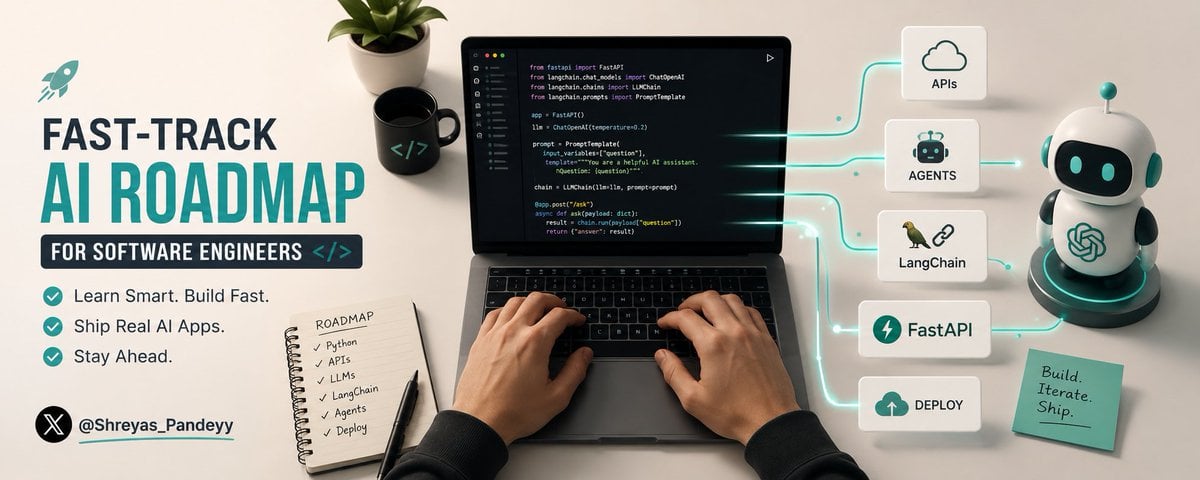
AI Engineering Roadmap for Software Engineers
Fast-Track · For Software Engineers
Already know Python and FastAPI? Skip the theory-heavy track. This is your direct path to building and deploying agentic AI systems — in weeks, not months.
Total time: 10–16 weeks | Prerequisite: Python + FastAPI | ML Theory: Minimal — optional | Focus: Agents, LangChain, RAG, Production
The philosophy: You don't need to know how to train models to build world-class AI applications. Learn the API surface, the frameworks, and the agentic patterns. You can go deeper on model internals after you've shipped something real.
Phase 1 — Neural Network Intuition (~1 week, ~4 hrs of video)
You don't need to train models. But understanding what a neural network, attention, and a transformer are makes you 10× better at prompting, debugging agent failures, and knowing what's possible. This phase is videos only — no coding required.
3Blue1Brown — Neural Networks (Chapters 1–4)
What is a neural network, how does gradient descent work, what is backpropagation. ~2 hours. The best visual explanations on the internet. Watch at 1.25×.
→ youtube.com/playlist?list=PLZHQObOWTQDNU6R1_67000Dx_ZCJB-3pi
3Blue1Brown — Transformers & Attention (Chapters 5–7, same playlist)
How transformers work, what attention means, why tokens matter. ~2 hours. After this you'll understand what GPT-4 is doing at a mechanical level.
→ Same playlist as above.
Phase 2 — LLM APIs & Prompt Engineering (~1–2 weeks)
OpenAI API Docs — Chat Completions + Function Calling
Read: messages, roles, temperature, tool calling, structured outputs, and embeddings. Build a simple FastAPI wrapper around the Chat API on day 1.
→ platform.openai.com/docs/overview
Anthropic Claude Docs — Tool Use & Long Context
Claude has first-class tool use and leads on long-context tasks. Study the tool use guide and prompt engineering best practices page.
→ docs.anthropic.com/en/docs/welcome
Prompt Engineering Guide — DAIR.AI
Chain-of-thought, few-shot, zero-shot, ReAct prompting, and structured output techniques. The most comprehensive free reference. Read the core techniques section.
ChatGPT Prompt Engineering for Developers — DeepLearning.AI (Free)
1.5-hour free course by Andrew Ng and OpenAI. Summarising, inferring, transforming, expanding, building a chatbot. Highly practical, Jupyter-based.
→ learn.deeplearning.ai/courses/chatgpt-prompt-eng-for-devs
Phase 3 — LangChain, RAG & Vector Stores (~2–3 weeks)
LangChain — Official Python Docs
Start with LCEL (LangChain Expression Language), build a simple chain, then move to retrievers. Read the conceptual guide before the how-to guides. Do the RAG quickstart end-to-end.
→ python.langchain.com/docs/introduction
RAG Pipeline from Scratch
Chunking strategies (recursive, semantic), embedding models (OpenAI text-embedding-3-small, nomic-embed-text), vector stores (Chroma, Qdrant), cosine similarity retrieval, re-ranking.
→ Chroma: docs.trychroma.com
→ Qdrant: qdrant.tech/documentation
LangChain for LLM Application Development — DeepLearning.AI (Free)
Free short course covering models, prompts, chains, memory, agents, and Q&A over documents. A practical companion to the LangChain docs.
→ learn.deeplearning.ai/courses/langchain
HuggingFace LLM Course — Chapters 1–4
Covers Transformers library, pipelines, tokenizers, and fine-tuning fundamentals. Do this to understand how open-source models work and how to swap proprietary APIs for open alternatives.
→ huggingface.co/learn/llm-course/en/chapter1/1
Phase 4 — Agentic Frameworks (~2–3 weeks, the core of this roadmap)
LangGraph — Stateful Agent Framework
Build stateful, cyclical agent graphs with nodes, edges, and checkpointing. Key patterns: ReAct agents, human-in-the-loop, multi-agent supervisor, streaming. Do the full quickstart + tutorials in the docs.
→ langchain-ai.github.io/langgraph
OpenAI Agents SDK
Lightweight, production-ready agentic framework from OpenAI. Handoffs between agents, guardrails, tool calling, and streaming. Read the entire quickstart — it's short and excellent.
→ openai.github.io/openai-agents-python
HuggingFace AI Agents Course (Free + Certificate)
Free certified course covering smolagents, LangGraph agents, tool calling, multi-agent systems, and vision agents. One of the most practical agent courses available.
→ huggingface.co/learn/agents-course/en/unit0/introduction
Model Context Protocol (MCP) — Anthropic
The standard for connecting agents to external tools and data sources. Build an MCP server with 3–4 tools in Python. Connect to Claude or a LangGraph agent. This is where agents become genuinely useful.
→ modelcontextprotocol.io/introduction
Tool Calling Mastery
Write Pydantic schemas for tools, handle parallel tool calls, implement retry logic for failed tool execution, and parse structured model outputs.
→ OpenAI function calling guide: platform.openai.com/docs/guides/function-calling
Phase 5 — FastAPI Integration & Production (~2 weeks)
Agent-as-API Pattern
Expose your LangGraph or OpenAI Agents SDK agent as a FastAPI endpoint. Handle streaming with Server-Sent Events (SSE), async tool execution, session management with a checkpointer (SQLite/Redis), and auth.
LangSmith — Tracing & Evaluation
Trace every LLM call in your agent. Set up a basic evaluation suite. Essential for debugging why your agent is failing and proving it works before shipping.
Langfuse — Open-Source Observability
Self-hostable alternative to LangSmith. Traces, scores, and session tracking. Add it with 3 lines of code. Run locally with Docker Compose for a fully owned observability stack.
Deploy: Docker + Cloud
Containerise your FastAPI + agent app. Deploy to Railway, Render, or AWS ECS. Use environment variables for API keys. Add a Redis container for agent memory persistence. Set up basic health checks.
→ Docker: docs.docker.com/get-started
Build These 5 Projects
Ship one per phase — they build on each other.
Project 1 (Phase 2) — Smart Q&A API
A FastAPI endpoint that takes a question, calls OpenAI, and returns a streamed answer. Add basic conversation history (last 10 messages).
Stack: FastAPI, openai SDK, SSE
Project 2 (Phase 3) — Document RAG System
Upload PDFs or text files → chunk → embed → store in Chroma → query with conversational memory. Add re-ranking. Expose as a FastAPI service.
Stack: LangChain, Chroma, FastAPI, Pydantic
Project 3 (Phase 4) — Web Research Agent
Agent that searches the web (Tavily API), reads pages, summarises findings, and returns a structured report. Built with LangGraph. Full ReAct loop with tool calling.
Stack: LangGraph, Tavily, FastAPI
Project 4 (Phase 4) — Multi-Agent Task Orchestrator
A supervisor agent routes subtasks to specialist agents (researcher, writer, reviewer). Agents communicate via state. Demonstrates handoffs and parallel execution.
Stack: LangGraph, OpenAI
Project 5 (Phase 5) — Production Agent API
Containerised FastAPI service wrapping your research agent. Streaming responses, Redis checkpointer for memory, Langfuse for tracing, Docker Compose for local dev, deploy to Railway.
Stack: FastAPI, LangGraph, Redis, Langfuse, Docker
Skills Checklist — You're Production-Ready When You Can Check All of These
- Call OpenAI & Anthropic APIs with proper error handling and retries
- Write Pydantic tool schemas and handle parallel tool calls
- Build a RAG pipeline with chunking, embedding, retrieval, and re-ranking
- Implement a LangGraph stateful agent with human-in-the-loop
- Expose an agent as a streaming FastAPI endpoint with SSE
- Add tracing and evaluation with LangSmith or Langfuse
- Containerise and deploy an agent service with Docker
- Implement agent memory with Redis or SQLite checkpointers
- Build and connect an MCP server
- Debug an agent failure by reading traces, not guessing
Optional — ML Theory (Return Here After the Core Track)
These are not required to build great agentic applications. Come back when you want to go deeper than the API surface — understand model internals, do fine-tuning, or read research papers.
Neural Networks: Zero to Hero — Andrej Karpathy (Free)
Build backpropagation and a GPT from scratch. Deepens your mental model of LLMs dramatically.
→ Course site: karpathy.ai/zero-to-hero.html
→ YouTube playlist: youtube.com/playlist?list=PLAqhIrjkxbuWI23v9cThsA9GvCAUhRvKZ
Let's Build GPT — Andrej Karpathy (Free, 2 hrs)
The canonical build-a-transformer-from-scratch video. Do after Zero to Hero or as a standalone deep dive.
→ youtube.com/watch?v=kCc8FmEb1nY
ML Specialization — Andrew Ng (Coursera, Free Audit)
If you want to understand how models are trained, optimised, and evaluated. Gives the classical ML background that makes you a complete AI engineer.
→ coursera.org/specializations/machine-learning-introduction
All links verified. This is the condensed fast-track version. For deeper coverage including ML foundations, NLP courses, deep learning, and 8 projects - read the main AI Engineering Roadmap. Updated 2026.
Originally published on X →